
If you run a Sun Belt GC or sub, the most expensive seat on the org chart isn’t your VP of Ops, it’s the Superintendent who keeps your jobs profitable. Pay for that seat moved hard in 2025, and 2026 numbers are now in the field. Here’s what we’re seeing across our placement data.
Hiring for heavy civil, site development, paving, data center, rail, or wastewater work? Amundson Group is a construction-only recruiter. First qualified resumes in 7 hours. Send us the role or call (832) 558-7982.
Get the full 2026 Salary Guide (PDF)
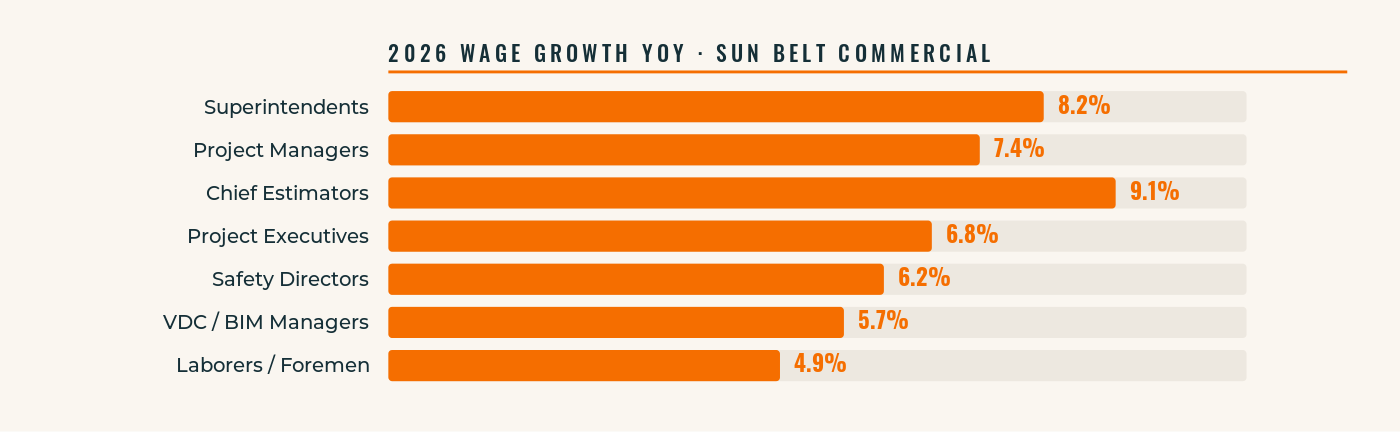
The headline number
Across our placements, base salary for Superintendents in heavy civil, site development, data center, and wastewater work across the Sun Belt rose 7 to 9 percent. The upper band ran hotter than the lower band, meaning experienced Supers (10+ years, complex commercial) saw real movement, while entry-level Asst Supers moved more modestly.
For context, the national construction average (per ENR and BLS proxies) was 4 to 5 percent. The Sun Belt outpaced the country by close to two full points.
Why the Sun Belt is paying more
Three things stacked at once:
- Demand outran supply. Texas, Georgia, and the Carolinas all added megaproject backlog (data center, semiconductor, EV battery, healthcare expansion) faster than the local labor market could absorb.
- The retirement cliff started. Roughly 55 percent of Senior Supers in the Sun Belt are projected to retire by 2035. The first wave is already out the door.
- Out-of-state recruiting drove offers up. When a national GC poaches a DFW Super for a Phoenix data center, the next DFW offer has to beat what’s now a national-market price.
Texas leads, but the gap is closing
DFW and Austin now pay above Houston at the mid-tier (8 to 12 years). That’s a 10-year reversal. Houston still leads at the senior tier on industrial and refinery work, but commercial Supers are seeing better offers up I-35.
For the metro-by-metro breakdown, see Texas construction salary by metro or jump to Dallas / DFW, Houston, and Austin.
What Florida looks like
Florida tracks 5 to 10 percent below Texas at the Super level, with Miami-Dade as the exception thanks to high-rise residential and mixed-use density. Tampa and Orlando are competitive on commercial but soft on industrial relative to Houston.
Sub-market detail: Tampa · Orlando · Miami · Jacksonville.
Carolinas: the surprise of 2025
North Carolina’s senior-tier Super pay now rivals DFW and Atlanta. That wasn’t true two years ago. Charlotte’s commercial pipeline and Raleigh-Durham’s life sciences and semiconductor work created a bidding floor that pulled the whole tier up.
South Carolina is tighter across metros but specialty premiums (Upstate automotive, Charleston industrial) close the gap on total comp.
What this means if you’re hiring
If your last Super offer is more than 12 months old, it’s stale. Open a new one against current market and expect a 6 to 9 percent jump. If you can’t move the base, move the bonus, the truck allowance, or the sign-on. Total comp closes the deal more often than base alone.
What this means if you’re a Superintendent
Run your own number. If you haven’t tested the market in two years, you are likely underpaid by 8 to 15 percent against a comparable job at a competitor. The guide’s percentile bands tell you exactly where you sit by metro and tenure.
Need to hire against these numbers? Our team places Superintendents, PMs, Estimators, and Executives across the Sun Belt every week. Talk to a recruiter and we will pull comps for your specific market and role.
Reviewed and updated October 12, 2026. Methodology note: Our salary data is drawn from our recruiting desks, across a network of 90,000+ construction professionals, and cross-checked against authoritative sources (BLS, AGC, ENR and industry surveys).
Need this hire made? Send us the role. Amundson Group is a construction-only recruiter based in Houston, placing across the United States: heavy civil, site development, paving, data centers, rail, tunnels, wastewater, and underground utilities. 1,200+ construction placements to date, a 90,000+ professional network, first qualified resumes in 7 hours. Inc. 5000 in 2024 and 2025.
Prefer to talk? Call (832) 558-7982 or use the full form at amundsongroup.com/hire-talent.
Looking for your next role? See open construction jobs.