
Texas is the largest construction economy in the South and the toughest hiring market the Sun Belt has seen in a decade. Pay differs by metro more than people assume. Here’s what 2026 looks like, city by city.
Hiring for heavy civil, site development, paving, data center, rail, or wastewater work? Amundson Group is a construction-only recruiter. First qualified resumes in 7 hours. Send us the role or call (832) 558-7982.
Get the full 2026 Salary Guide (PDF)
The big picture
Texas Super pay rose 7 to 9 percent in 2025. Three things drove it: data center buildout in DFW and the I-35 corridor, semiconductor fab work pulling Austin pay up, and refinery and petrochem demand keeping Houston tight on the industrial side.
Houston
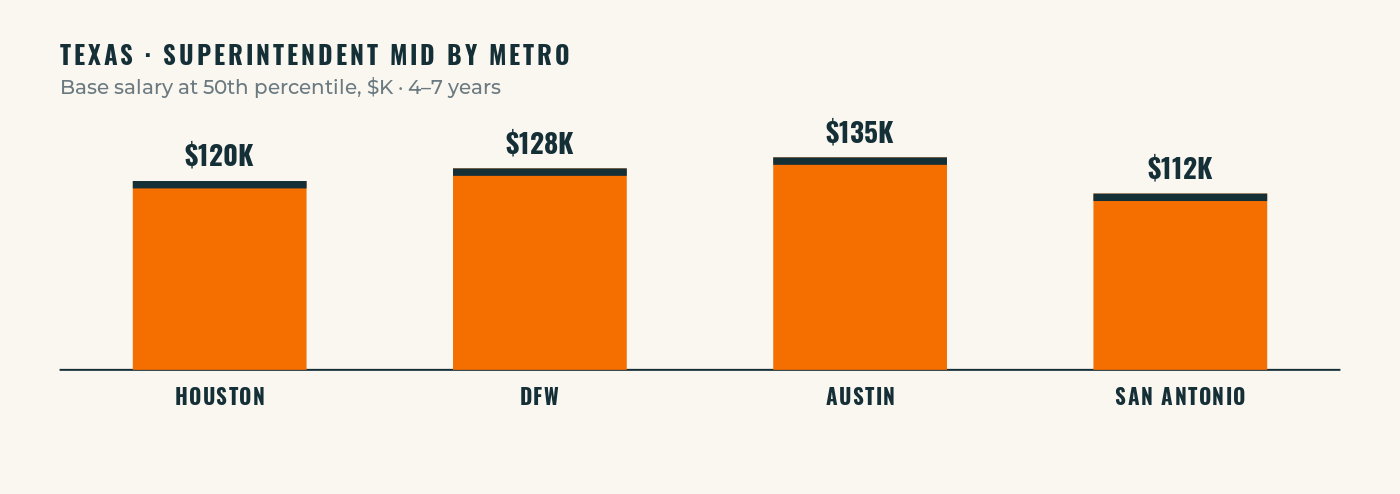
Houston is still the largest commercial construction economy in Texas by total volume, with industrial, healthcare, and Class A office work driving the most demand. Senior Supers on industrial and refinery work command the top of the Texas range, $165K to $185K base. Commercial Super pay sits 5 to 8 percent below DFW at the mid-tier, a reversal from 10 years ago.
Where Houston pays best: industrial, petrochemical, healthcare, mid-rise commercial. Where it lags: data center (smaller pipeline than DFW), high-rise office (slower than peak years).
Full Houston market detail: Houston construction recruiting.
Dallas / Fort Worth
DFW is the most competitive hiring market in Texas in 2026. Data center demand alone has reset the senior tier. Mid-tier Supers with 8 to 12 years of commercial experience are now seeing $135K to $148K base, up from $122K to $135K two years ago.
Add the hyperscale premium and a DFW data center Super realistically lands $143K to $151K base, with bonus and sign-on layered on top.
Where DFW pays best: data center, semiconductor (Sherman corridor), Class A commercial. Where it lags: industrial (Houston still leads).
Full DFW market detail: Dallas / DFW construction recruiting.
Austin
Austin is the smallest of the four major Texas metros by total construction volume but the most concentrated on premium specialty work. Samsung’s Taylor fab, Apple’s campus expansions, and life sciences buildout have made Austin a national-rate market for specialty Supers and PMs.
Mid-tier Austin Super pay matches or exceeds Houston now, especially on fab and life sciences. The cost of living premium gets baked into base.
Full Austin market detail: Austin construction recruiting.
San Antonio
San Antonio runs 8 to 12 percent below DFW and Austin on commercial Super pay. The pipeline is steady but smaller, and out-of-market poaching is less common, so the bidding floor is lower.
That said, San Antonio’s healthcare and mission-critical pipeline is growing, and we expect the gap to narrow over the next 18 months.
Full San Antonio market detail: San Antonio construction recruiting.
What this means if you operate across Texas
If you’re a multi-market GC, your DFW and Austin offers need a Texas-corridor premium baked in. A flat Texas pay scale costs you candidates in the two metros where the market has moved most. Build metro-specific bands and update them every six months, not every two years.
What this means for candidates
Geography matters more in Texas in 2026 than it did in 2020. Moving from San Antonio to DFW for a comparable job is a real raise, often 12 to 18 percent on base before any sign-on or relo. Moving from Houston to Austin on the specialty side can be similar.
Need to hire against these numbers? Our team places Superintendents, PMs, Estimators, and Executives across the Sun Belt every week. Talk to a recruiter and we will pull comps for your specific market and role.
Reviewed and updated August 9, 2026. Methodology note: Our salary data is drawn from our recruiting desks, across a network of 90,000+ construction professionals, and cross-checked against authoritative sources (BLS, AGC, ENR and industry surveys).
Need this hire made? Send us the role. Amundson Group is a construction-only recruiter based in Houston, placing across the United States: heavy civil, site development, paving, data centers, rail, tunnels, wastewater, and underground utilities. 1,200+ construction placements to date, a 90,000+ professional network, first qualified resumes in 7 hours. Inc. 5000 in 2024 and 2025.
Prefer to talk? Call (832) 558-7982 or use the full form at amundsongroup.com/hire-talent.
Looking for your next role? See open construction jobs.