Hyperscale data center work is the highest-margin sector in commercial construction right now, and the wage premium reflects it. If you’re hiring on the data center side, or you’re a Super or PM trying to break in, here’s what the 2026 numbers actually say.
Hiring for heavy civil, site development, paving, data center, rail, or wastewater work? Amundson Group is a construction-only recruiter. First qualified resumes in 7 hours. Send us the role or call (832) 558-7982.
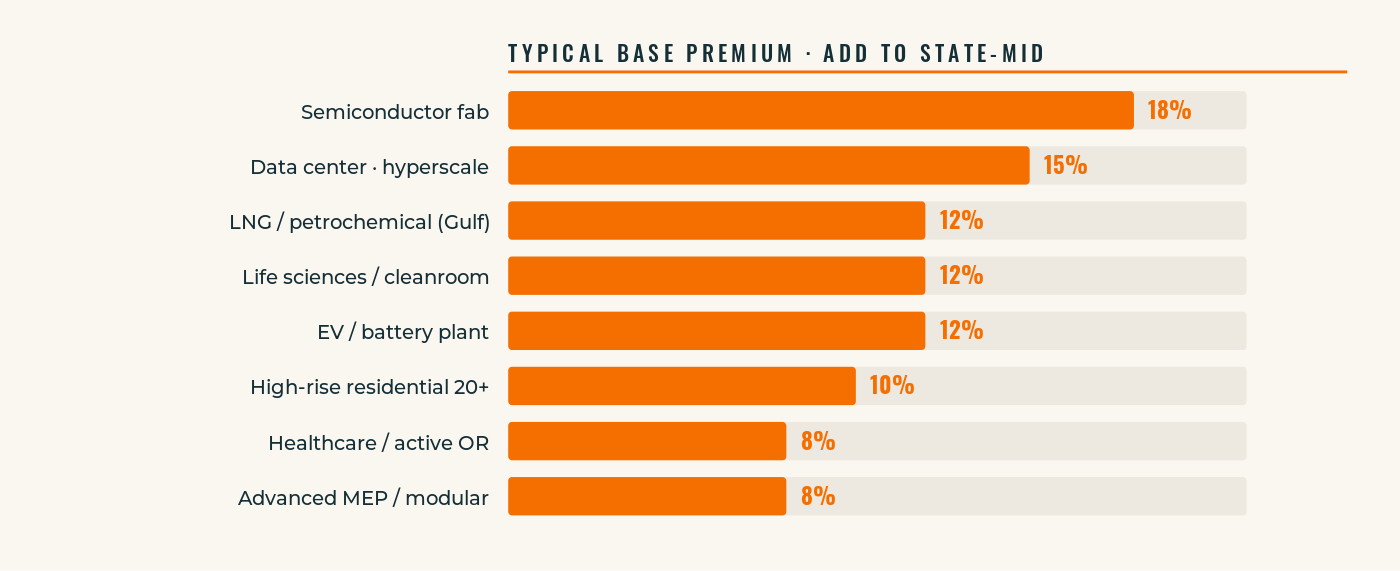
Specialty base premium added on top of base metro pay.
What the premium looks like
A DFW commercial Superintendent at the mid-tier earns base in the high $120Ks. Move that same Super onto a hyperscale data center build and the offer jumps into the $143K to $151K range. That’s a 14 to 18 percent base premium before any bonus, sign-on, or per diem.
The premium is even larger on the PM side. Senior PMs running mission-critical work in DFW, Atlanta, or the I-85 corridor are now routinely seeing $165K to $185K base.
Why it’s so high
Three reasons compound:
The qualified pool is small. You can train a Super on a Class A office tower in 18 months. Hyperscale electrical, MEP coordination, and commissioning standards take 5+ years of repeated reps to internalize.
Schedule risk is brutal. A two-week delay on a $400M data center costs the owner real money. Owners pay GCs to bring proven people, and GCs pay those people what it takes to keep them.
National competition. The same handful of hyperscale-experienced Supers and PMs get called by every national GC building for AWS, Microsoft, Meta, and Google. Local market rates don’t apply.
Where the work is
The Sun Belt data center map is concentrated in:
DFW (largest, most active, deepest talent pool). See Dallas / DFW.
Atlanta Metro (now a top-3 US data center market). See Atlanta.
Phoenix corridor (out-of-region, but pulling Sun Belt talent west).
Northern Virginia (out-of-region, but anchoring the national rate ceiling).
Adjacent specialty premiums
Data center isn’t the only premium sector. Semiconductor fab (Austin, Phoenix) carries a similar 12 to 16 percent base premium. Life sciences (Raleigh-Durham, Boston-out) sits around 10 to 14 percent. Healthcare premiums are smaller, 5 to 8 percent, but more widely distributed across metros.
For the full premium table by sector and role, see the 2026 Salary Guide specialty section.
What this means for hiring managers
If you’re competing for a hyperscale-experienced Super and you anchor on a commercial market rate, you’ll lose the candidate. Build the offer at base + sector premium + bonus target + sign-on, and present it as one number. Candidates compare total comp; presenting a sliced offer hurts you.
What this means for candidates
If you have hyperscale or fab experience and you’ve stayed at the same GC for 4+ years, you’re almost certainly underpriced. The market has moved twice since most existing comp packages were set.
Need to hire against these numbers? Our team places Superintendents, PMs, Estimators, and Executives across the Sun Belt every week. Talk to a recruiter and we will pull comps for your specific market and role.
Reviewed and updated August 12, 2026.Methodology note: Our salary data is drawn from our recruiting desks, across a network of 90,000+ construction professionals, and cross-checked against authoritative sources (BLS, AGC, ENR and industry surveys).
Need this hire made? Send us the role. Amundson Group is a construction-only recruiter based in Houston, placing across the United States: heavy civil, site development, paving, data centers, rail, tunnels, wastewater, and underground utilities. 1,200+ construction placements to date, a 90,000+ professional network, first qualified resumes in 7 hours. Inc. 5000 in 2024 and 2025.